




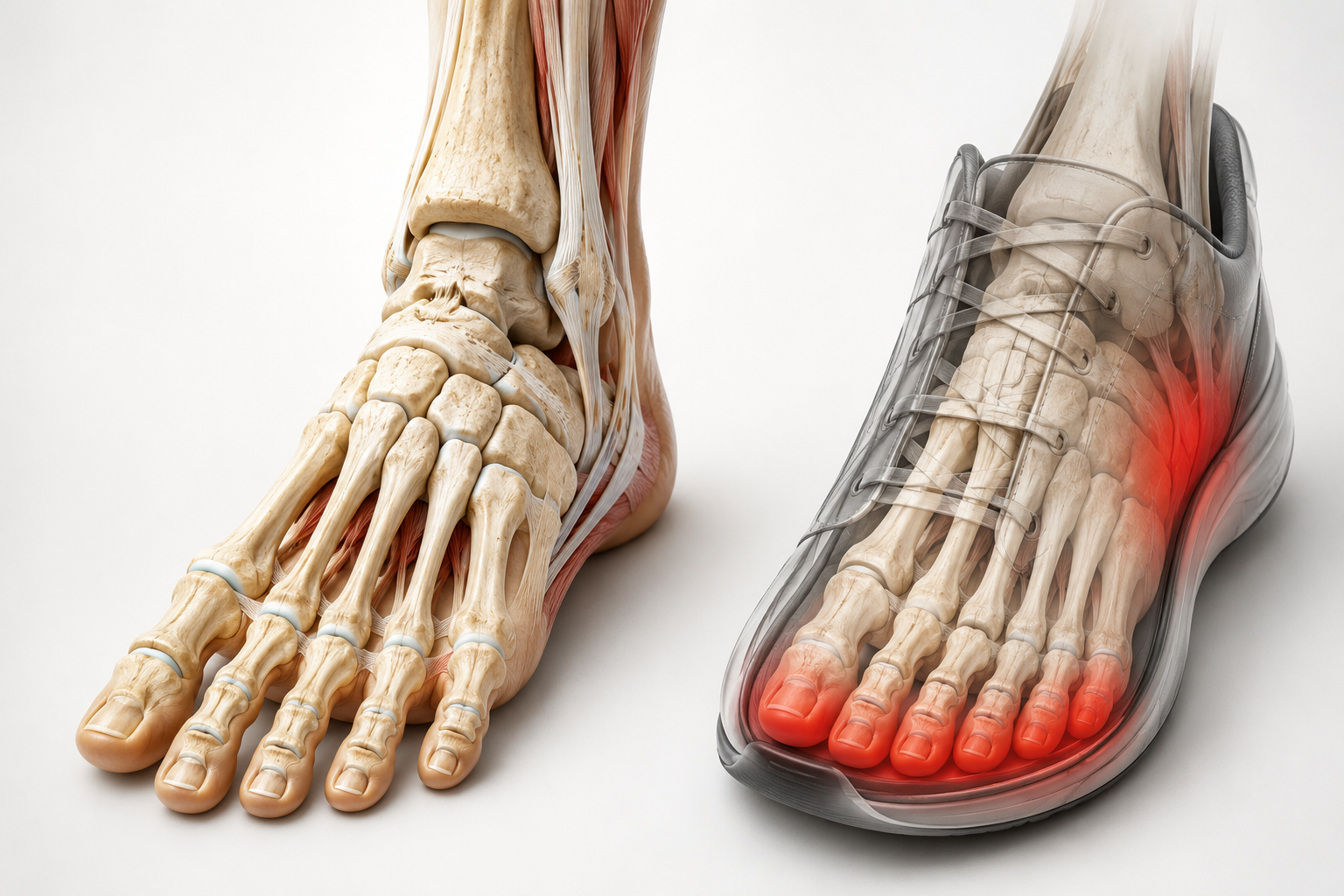
Your foot is not a simple structure. It is one of the most precisely engineered systems in the human body, built over millions of years to carry you across every kind of terrain imaginable.
26 bones. 33 joints. More than 100 muscles, tendons, and ligaments. All working together in a coordinated sequence with every single step you take.
And then you put a shoe on. And most of that system quietly switches off.
Understanding how shoes damage your feet is not about blaming footwear in general. It is about understanding what happens when a highly adaptable, dynamic structure is placed inside a rigid box designed around aesthetics rather than anatomy. The damage is slow, silent, and almost universal. By the time most people notice something is wrong, the pattern has been years in the making.

The Foot Is Not a Passive Structure
Before understanding what shoes do wrong, it helps to understand what the foot does right.
The foot functions as three things simultaneously. It is a shock absorber, cushioning the impact of each step before it reaches the knees and spine. It is a propulsive engine, generating the push-off force that moves you forward. And it is a sensory platform, reading the ground beneath you and sending signals that help your entire body balance and adapt in real time.
To do all three, the foot relies on movement. The 33 joints inside it are not decorative. Each one plays a role in distributing load, adapting to uneven surfaces, and transferring force efficiently through the body. When those joints are restricted, the system compensates. And compensation sustained over months and years is where injury begins.
Foot health in India is rarely discussed as a systemic issue. Most people treat foot pain as an isolated complaint, something to be managed with insoles or rest, rather than a signal worth investigating at its source. In cities like Bengaluru, Mumbai, Delhi, and Hyderabad where people walk significant distances daily on hard concrete surfaces, the demands placed on feet are substantial. What they are walking in matters enormously.
Three Ways Modern Shoes Break This System
The Toe Box Is Narrower Than Your Foot
The widest part of a natural human foot is at the toes. Toe splay, the ability of the toes to spread apart during weight bearing, is essential for balance, stability, and efficient push-off with every step.
Most conventional shoes are narrowest at exactly this point. The toe box tapers to match a silhouette rather than the foot inside it. Over time, toes are trained into a compressed position. The muscles responsible for natural toe movement weaken from disuse. Joints lose their range of motion. Bunions form gradually at the base of the big toe as the bone is pushed out of alignment by sustained pressure.
A shoe with a wide toe box simply matches the foot at its widest point. It is one of the most straightforward improvements footwear can make, and one of the most consistently ignored by the mainstream shoe industry.

The Heel Is Higher Than It Should Be
A typical office shoe or sports trainer has a heel sitting 10 to 25mm higher than the forefoot. This elevation, present even in shoes marketed as flat, does something significant to the body’s mechanics.
When the heel is raised, the body’s centre of gravity shifts forward. The knees soften into a slight compensatory bend. The hips tilt forward. The lower back arches to counterbalance. Over time this altered posture becomes the body’s default. Calf muscles shorten and tighten. The Achilles tendon loses flexibility. The entire posterior chain adapts to a position it was never designed to hold for hours every day.
This explains why so many working adults in Chennai, Pune, and across urban India who spend long hours in formal footwear develop knee pain and lower back issues that feel entirely disconnected from their shoes. The connection is direct, even if it is rarely made.
Zero drop footwear places the heel and forefoot at the same height. The foot sits flat, the way it naturally does on open ground. The chain of compensation up through the ankle, knee, hip, and spine has nothing to correct for.
The Sole Is Too Stiff to Allow Natural Movement
A sole that does not flex is a sole that does the foot’s work for it. This sounds supportive. In practice, it is the opposite.
The intrinsic muscles of the foot, the small muscles that stabilise the arch, control toe movement, and fine-tune balance at every step, need to be used to remain functional. A rigid sole eliminates the need for them. They stop working. They atrophy. The arch loses its active support and begins depending on the external structure of the shoe to hold it up.
This is how conventional footwear creates the very problem it claims to solve. The more structural support a shoe provides, the less the foot’s own muscles do. The weaker those muscles become, the more external support the foot genuinely needs. It is a cycle that most people never recognise because it unfolds slowly over years, not days.
A flexible sole reverses this. Natural foot movement returns. The muscles re-engage. Ground contact, pressure, and surface variation all feed back into the foot’s sensory system. The foot begins doing what it was built to do.
The Bigger Picture: Foot Health and the Whole Body
How shoes damage your feet is ultimately a story about posture, load, and compensation.
When the foot is restricted, compressed, and elevated at the heel, the body adapts. Every joint above the foot adjusts to the altered mechanics below it. These adaptations are efficient in the short term. Over years they become the source of pain that most people never trace back to their footwear.
Plantar fasciitis, one of the most common complaints among working adults in India, is frequently a downstream result of weakened intrinsic foot muscles and altered load distribution. Knee pain, hip tightness, and lower back discomfort follow the same logic.
None of this is inevitable. Most of it is a function of what is on the foot, not what is wrong with the foot.
What the Foot Actually Needs From a Shoe
Restoring natural foot movement does not require complicated interventions. It requires removing the things that interfere with it.
The foot needs a shoe that is widest where the foot is widest. It needs a sole that sits level, without elevating the heel above the forefoot. And it needs to flex, bend, and respond to the ground rather than acting as a rigid platform that overrides every signal the foot is trying to send.
These are not new ideas. They are the principles that barefoot shoes India consumers are increasingly turning to, and that foot health specialists have been pointing toward for years. The foot’s design has not changed. The question is simply whether the shoe around it is working with that design or against it.

At Baer Shoes India, every shoe starts from the same place: the natural anatomy of the human foot. Wide toe box, zero drop sole, flexible construction. The same three commitments the brand has maintained since it was founded in Germany in 1982 and has been crafting in Ambur, Tamil Nadu since 1995.
If you want to see what this looks like in practice, explore the full Baer range.
Your feet have been adapting to the wrong conditions for years. Giving them the right ones is a straightforward place to start.
Share:
The Difference Between a Comfortable Shoe and a Shoe That’s Good For You
The Hidden Cost of Cheap Footwear